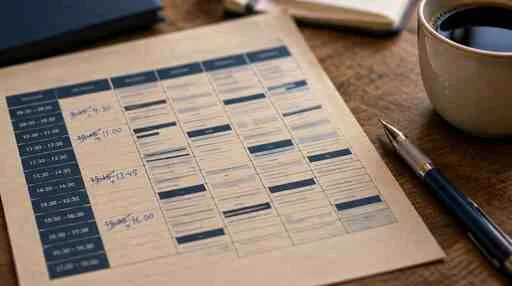
The available announcements establish the conference dates as May 6–9, 2018, and describe a program of more than 140 sessions. They do not, by themselves, provide a complete, versioned agenda. This page explains which details a reader should retain before quoting a schedule item.
Fields that make an agenda verifiable
A useful program record carries the event edition, session title, presenter, track, local time, room and any revision date. Preserve the time zone because an online copy can be read outside Florida. If a listing omits a field, record it as unavailable rather than inferring it from a session theme or another event year.
Opening and closing keynotes were separately announced for May 7, May 8 and May 9. The keynote announcement identifies the speakers and timing, while a general session announcement groups many other sessions by theme. Those are different source types and should not be merged into a made-up full timetable.
Reading the program as a participant
Tracks were intended for different professional roles, including executives, marketers, fundraisers, membership teams, finance specialists and technology staff. When comparing sessions, note the audience and format—lecture, hands-on training, support lab or small-group meeting—because they imply different participant expectations.
Related archive pages
Use Sessions for the announced content areas, Registration for the period-specific pass context, and Travel for venue details. The home archive places these routes in the broader event history.
Keynotes listed by the organizer
Community Brands’ February 22 announcement identified three keynote appearances: CEO Jean-Paul (JP) Guilbault was scheduled to open on Monday, May 7, at 9 a.m.; Linda Bernardi was listed for Tuesday, May 8, at 9 a.m.; and Dr. Derreck Kayongo was listed to close Wednesday, May 9, at 9:30 a.m. The announcement placed the keynotes at the Walt Disney World Swan and Dolphin Resort.
These dated keynote details should be kept separate from a complete conference timetable. The organizer’s session announcements named many concurrent topics, but a title list is not enough to reconstruct each room, track or transition. If you cite a keynote, retain the speaker name, date, time and event edition together; if you cite another session, use the corresponding dated program record.
Read schedule records with their version
Schedules can be updated after publication. Check whether a copy identifies its revision, local time zone, room and track. Do not infer missing details from a promotional paragraph or from a later Xperience conference. For the variety of session topics, see Sessions; for the physical setting, see Venue and travel.
Check an agenda entry against its dated version
Session times and locations can change between program releases.
- Record the agenda version and event date.
- Verify the session title, time, track and room against that copy.
- Keep keynote listings distinct from broader program themes.
Questions about schedule evidence
Who were the announced keynote speakers?
The organizer named Jean-Paul Guilbault, Linda Bernardi and Dr. Derreck Kayongo.
Does the announcement provide a complete agenda?
No. It lists keynotes and session themes but is not a complete versioned timetable.
Examples of themes across professional roles
Technology and developer sessions addressed systems and product use; fundraising and marketing sessions addressed donor and member communication; finance sessions concerned internal controls and organizational operations; leadership sessions considered how organizations adapt to changing expectations. These are broad groupings drawn from the event announcement, not a reconstruction of every time slot.
A citation to a specific keynote can include its announced time, but should still say that it was scheduled. For other sessions, use a dated program copy. If a program copy cannot be verified, link to the session themes rather than inventing the room or presenter.